
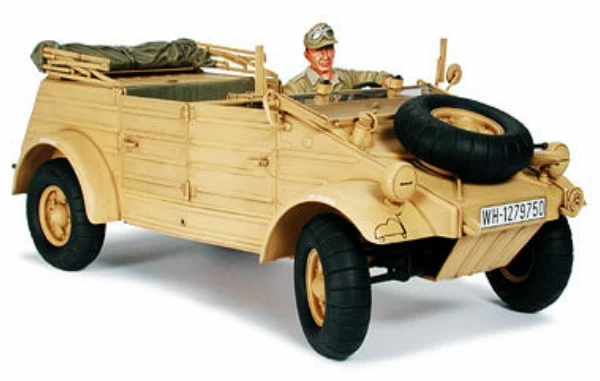
Tamiya 36202 1/16 German Kubelwagen Type82
Oorspronkelijke prijs was: 93,33 €.65,33 €Huidige prijs is: 65,33 €.
TA36202 Kubelwagen Type 82 Africa Corps
- Gestroomlijnde service, ontworpen voor uw gemak.
- Veilig betalen, de slimme keuze
- Uw geluk, onze missie.
- Betrouwbare betalingen voor betrouwbaar winkelen

About the model
- 1/16 scale plastic model construction kit
- Overall length: 238mm, overall width: 103mm, overall height: 93mm
- Precisely replicated balloon tire equipped Kubelwagen Type 82 – Africa version Instrument panel, seats and 4-wheel independent suspension system are also reproduced realistically.
- All the doors and engine room cover can be modeled in either open or closed position.
- The engine room shows mechanical equipment including air cleaner, 4 cylinder horizontally opposed air cooled engine and repair tools
- Balloon tires are of semi-pneumatic rubber and front wheels are steerable.
- Includes accessories such as jerry cans and canteen for drinking water, Rommel figure and a driver figure.
It was September of 1940 and Germany’s Italian ally was unsuccessfully attempting to invade British-occupied Egypt. To support Italy in their struggle against the British, Germany deployed the German Africa Corps, which was comprised of the 5th Leichte (Panzer) Division and the 15th Panzer Corps, to Tripoli. The man chosen to lead this fighting force was Lieutenant General Erwin Rommel, who had already earned a glorious reputation for commanding the 7th Panzer Division, a.k.a. the Phantom Division during the Battle of France. This nickname stems from the fact that no one knew its true whereabouts, including the German High Command and even Rommel’s own staff! From February of 1941 to May of 1943, despite serious shortages of supplies and weaponry, the Africa Corps lead by Rommel fought an ardous desert war, at one point managing to chase the Allies as far back as E! Alamein, North Africa. The military vehicle that earned Rommel’s trust on the searing African desert was the Kubelwagen Type 82.
Construction and Performance
The Kubelwagen Type 82 featured a simple, utilitarian design. Its trustworthy powerplant consisted of a 4-cylinder, horizontally opposed, air-cooled engine, capable of 23.5hp at 3000rpm. Its displacement was 985cc and provided a top speed of 80km/h. In March of 1943, the power of the engine was increased to 25.5hp. The engine was reliable and easy to maintain, which proved to be a boon in both the broiling North African theater and frigid Eastern European Front. The chassis consisted of a semi-tubular backbone, to which the front and rear axles attach. Above that, a pressed steel floor, ribbed for rigidity, formed the base of the base of the cab. All wheels were independently sprung and torsion rods were used instead of the common leaf springs. The body was also simple and lightweight, consisting of thin iron stampings. Although most Kubelwagens were equipped with only rear and wheel drive, because they weighed a mere 700kg, they displayed excellent cross-country capability, and could be lifted out of trouble by only two or three soldiers.
X-10 – Gun Metal
X-11 – Chrome Silver
X-12 – Gold Leaf
X-18 – Semi Gloss Black
X-25 – Clear Green
X-31 – Titanium Gold
X-4 – Blue
X-5 – Green
X-7 – Red
XF-1 – Flat Black
XF-10 – Flat Brown
XF-11 – J.N. Green
XF-15 – Flat Flesh
XF-16 – Flat Aluminum
XF-2 – Flat White
XF-49 – Khaki
XF-56 – Metallic Grey
XF-57 – Buff
XF-58 – Olive Green
XF-59 – Desert Yellow
XF-60 – Dark Yellow
XF-64 – Red Brown
XF-65 – Field Grey
XF-7 – Flat Red
Wees de eerste om “Tamiya 36202 1/16 German Kubelwagen Type82” te beoordelen
Gerelateerde producten
Ship Plastic Kits
Military Ships Plastic Kits
Ship Plastic Kits
Ship Plastic Kits
Military Ships Plastic Kits
Military Ships Plastic Kits
Ship Plastic Kits
1:32 Scale Airplane Plastic kits
Beoordelingen
Er zijn nog geen beoordelingen.